“Xiaomi 15T Pro review 2025: Leica camera test, gaming performance, battery life, and Realme GT 7 Pro comparison—find out if it’s worth buying.”
The Mid-Flagship Dilemma
Every year, smartphone buyers face the same frustrating question: Do I really need to spend over $1,000 for a flagship, or can I get 90% of the experience for much less? The so-called “mid-flagship” category has exploded because people are tired of compromises. They want a phone that can handle demanding games, capture stunning photos, and last through a busy day—without draining their wallets.
The Xiaomi 15T Pro is Xiaomi’s answer to this demand. It promises Leica-powered cameras, a blazing-fast MediaTek Dimensity 9400+ chip, and premium design at a price that undercuts Samsung and Apple. But does it actually solve the pain points that plague mid-range buyers? And how does it stack up against its fiercest rival, the Realme GT 7 Pro? Let’s break it down.

Why Mid-Flagships Often Disappoint
Many people struggle with phones that look great on paper but fail in real-world use. Specs sheets are filled with buzzwords—“AI-enhanced cameras,” “flagship-grade gaming,” “all-day battery”—yet when you actually use the device, the cracks show.
- Cameras that boast 100MP sensors but produce noisy, oversharpened images.
- Gaming phones that throttle after 10 minutes of Genshin Impact.
- Batteries that drain faster than expected, despite “fast charging.”
For buyers in the Philippines and other price-sensitive markets, this is more than an inconvenience—it’s wasted money. A ₱40,000 purchase is a serious investment, and nobody wants to feel shortchanged.
The Cost of Compromise
The worst part? Most of the other options make you select between strengths. One phone can have a wonderful camera but not be good for gaming. Another can have a long battery life but seem slow when you use it every day.
If you don’t make these compromises, you’ll be frustrated:
You missed out on several great photo possibilities since your ultrawide lens isn't very good.- You lost ranking matches because your phone got too hot during the game.
- You worry all the time that your phone won’t last until nightfall.
This pattern of compromise has made buyers doubt. They have come to expect to be let down. That’s why the Xiaomi 15T Pro has a lot to prove.
But “What If”…
Nevertheless, what if there existed a phone that did not require you to make a decision? Would you be interested in purchasing a device that could truly handle photography, gaming, and everyday reliability, but would not cost as much as a Galaxy Ultra?
In other words, this is what the Xiaomi 15T Pro stands for. According to the publication, it appears to be the unusual mid-flagship that does not take any shortcuts. The question is, does it live up to the hype?
The Solution: Xiaomi 15T Pro Review
Design & Build Quality
From the minute you take up the Xiaomi 15T Pro, you will get a luxury feeling from it. The construction is comparable to that of a flagship product, featuring Gorilla Glass 7i, an aluminum frame, and IP68 water resistance. It weighs 210 grams, which is significantly more than some of its competitors, but the weight contributes to the robust feel that it has.
The display has a gentle curve, the bezels are thin, and the matte texture discourages fingerprints from being left behind. It is not simply a “budget flagship”; rather, it has the appearance and the feel of a phone that might be much more expensive.
Display
- 6.83‑inch AMOLED
- 144Hz refresh rate
- 3200 nits peak brightness
- Dolby Vision HDR support
This is one of the brightest screens you can get. The 144Hz refresh rate makes scrolling and gaming very smooth, and the outdoor visibility is great. When you watch HDR content on Netflix or YouTube, the blacks are really deep and the colors are really bright.
Performance & Gaming
Performance & Gaming
Under the hood, the Xiaomi 15T Pro runs on the MediaTek Dimensity 9400+ paired with the Immortalis‑G925 GPU. Benchmarks put it close to Qualcomm’s Snapdragon 8 Elite, which powers the Realme GT 7 Pro.
Gaming Test Results:
- Genshin Impact (Ultra settings): 58–60 FPS, minor dips after 20 minutes
- Call of Duty Mobile: Locked 120 FPS, stable
- Mobile Legends (Ultra): 144 FPS mode supported
Thermals are well‑managed, though extended sessions do warm the device. Xiaomi’s cooling system prevents severe throttling, but hardcore gamers may notice slight dips in frame rates after 30 minutes.
Verdict: For 99% of users, this is more than enough power. Only the most demanding gamers will push it to its limits.
Camera System (Leica Partnership)
This is where Xiaomi flexes its muscles. The Leica co‑engineered camera system is the star of the show.
- 50MP Light Fusion 900 main sensor (OIS)
- 50MP periscope telephoto (5x optical zoom)
- 12MP ultrawide
- 32MP selfie camera
Strengths:
- The 5x telephoto zoom is rare at this price point and produces sharp, detailed shots.
- Low‑light performance is excellent, with natural colors and minimal noise.
- Video recording supports 8K and Dolby Vision HDR, making it a strong choice for content creators.
Weaknesses:
- The ultrawide is serviceable but not class‑leading.
- Color science leans cooler compared to iPhones, which some may find less flattering for skin tones.
Overall, this is one of the best camera systems in its class, especially for zoom photography.
Battery & Charging
- 5500mAh battery
- 90W wired charging
- 50W wireless charging
The phone lasts a full day of heavy use in the real world. It runs out of power faster when you play games or use the camera, but the 90W charger can fully charge it in less than 40 minutes. At 50W, wireless charging is faster than most high-end phones.
Xiaomi’s charging speed is a little slower than Realme GT 7 Pro’s 6500mAh + 120W, but the difference isn’t that big in everyday use.
Software: HyperOS 2
It comes pre-installed with HyperOS 2, which is based on Android 15, the Xiaomi 15T Pro. Although there is still some bloatware, it is more streamlined and less cluttered than previous versions of MIUI. While Xiaomi’s pledge of four years of operating system upgrades and five years of security fixes is competitive, it is not nearly on par with Samsung’s commitment.
Comparison: Xiaomi 15T Pro vs Realme GT 7 Pro
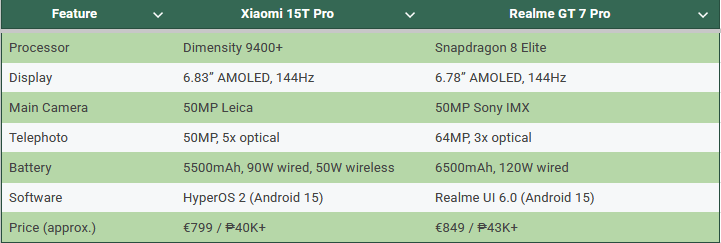
Takeaway:
- Xiaomi wins on camera versatility (5x zoom, Leica partnership).
- Realme wins on battery size and charging speed.
- Both are excellent performers, but Xiaomi edges ahead for photography enthusiasts, while Realme appeals to power users who prioritize endurance.
Pros & Cons
Pros
- Excellent 5x telephoto zoom
- Bright 144Hz AMOLED display
- Premium build with IP68 rating
- Strong gaming performance
- Fast wired and wireless charging
Cons
- Ultrawide camera is average
- Slightly heavy at 210g
- HyperOS still has some bloatware
- Battery life not class‑leading
FAQs (People Also Ask)
Q: Is the Xiaomi 15T Pro good for gaming? Yes. It handles demanding titles smoothly, though extended sessions may cause mild throttling.
Q: How does the Xiaomi 15T Pro camera compare to Realme GT 7 Pro? Xiaomi’s 5x Leica telephoto zoom gives it an edge, while Realme offers a larger battery.
Q: Does the Xiaomi 15T Pro support wireless charging? Yes, up to 50W—faster than many flagships.
Q: Is the Xiaomi 15T Pro worth it in the Philippines? At around ₱40K, it’s one of the best mid‑flagship options, especially for photography and gaming.
Final Verdict: Is the Xiaomi 15T Pro Worth It?
The Xiaomi 15T Pro isn’t perfect, but it’s one of the few mid-range flagships that really works where it counts. The Leica-designed 5x telephoto zoom is a real standout feature that gives you photography possibilities that even more expensive flagship phones don’t often have. The 144Hz AMOLED display makes everything look sharp and clear, and the Dimensity 9400+ CPU makes gaming seamless and responsive. With 90W wired and 50W wireless charging, this phone feels like a high-end one without the high price.
There are, of course, trade-offs. The ultrawide camera is okay, the phone is a tad heavy, and Realme’s GT 7 Pro has a bigger battery and charges faster than this one. HyperOS 2 is cleaner than prior MIUI releases, although it still has certain apps already installed that you probably won’t need.
Xiaomi has found a good mix between pricing and performance that will appeal to a lot of people. You can buy a phone that competes with ones that cost hundreds of dollars more for about ₱40K / €799.
- If photography is your priority, especially zoom shots, the Xiaomi 15T Pro is the better buy.
- If you want the absolute biggest battery and fastest charging, the Realme GT 7 Pro may be more your style.
But for most individuals, the Xiaomi 15T Pro is the safest choice. This phone doesn’t simply look excellent on paper; it works where it counts. And in a market where people have to make trade-offs, that alone makes it worth thinking about.
Call to Action
With the Xiaomi 15T Pro, the company is not aiming to be flawless; rather, it is attempting to be useful. It is successful in accomplishing that purpose. You are receiving a phone that is perfect in every way: it has a camera system that is powered by Leica and actually has a 5x zoom, it has a flagship-class CPU that is capable of handling heavy gaming, and it has a premium design that gives the impression of being much more costly than its price tag says.
Certainly, the ultrawide camera is not particularly impressive, and the Realme GT 7 Pro is superior in terms of both the raw battery size and the charging speed. However, when taking into consideration the entirety of the package, these trade-offs are very agreeable for the majority of purchasers. Around ₱40,000 or €799, the Xiaomi 15T Pro offers a level of performance and polish that is comparable to that of competitors that cost hundreds of dollars more.
If photography and gaming are your primary concerns, then this is the mid-flagship that you should strive to surpass in the year 2025.
Ready to Decide?
If you’re leaning toward the Xiaomi 15T Pro, don’t wait too long—early stocks tend to move quickly, and launch pricing rarely lasts.
Ready to Decide?
If you’re leaning toward the Xiaomi 15T Pro, don’t wait too long—early stocks tend to move quickly, and launch pricing rarely lasts.
Click here for a XIAOMI product
Would you pick the Xiaomi 15T Pro for its Leica zoom and gaming chops, or does the Realme GT 7 Pro’s bigger battery tempt you more? Share your thoughts below—we’d love to hear what matters most to you.
Jo Parr combines technical expertise with human storytelling. His reviews go beyond features and specs, highlighting how technology impacts real life. He also shares inspiring stories of resilience, growth, and curiosity—connecting innovation with the human experience.
Sources:
You may also like:
- Huawei Mate 80 Rumored Specs and Review – A Game Changer!
- Important Differences Between the Galaxy M07 vs the Galaxy A07
Final Verdict: Xiaomi 15T Pro Review 2025
The Xiaomi 15T Pro delivers where it matters most: Leica-powered cameras, smooth gaming performance, and premium design at a price that undercuts many flagships. If you’re choosing between Xiaomi 15T Pro vs Realme GT 7 Pro, the Xiaomi edges ahead for photography and gaming, while Realme appeals to heavy battery users.