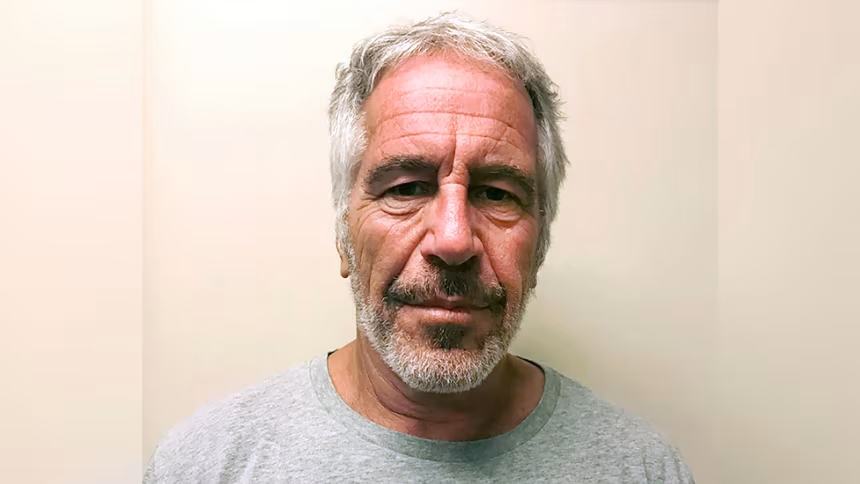

The shadow of Jeffrey Epstein continues to loom over American politics. Years after his arrest and death, his connections to powerful figures remain one of the most controversial stories in modern U.S. history. On Monday evening, the House Oversight Committee released a new set of documents, reviving interest in Epstein’s network and stirring political debate all over again.
Unlike some earlier batches of records that offered more rumor than revelation, these documents contained fresh details. Chief among them: a birthday note tied to former President Donald Trump, first reported by The Wall Street Journal in 2023, but now surfaced directly from Epstein’s estate.
The files don’t provide proof of illegal activity, but they raise new questions about how closely Trump and other influential figures were linked to Epstein — and how those connections are handled in today’s polarized climate.
Here are five major takeaways from the newly released documents, along with what they could mean for politics moving forward.
1. Trump’s Denials Face New Scrutiny
One of the most striking items in the release was a birthday letter for Epstein’s 50th birthday in 2003. The note, bearing Trump’s name and featuring a drawing of a female silhouette, adds a strange wrinkle to the already complex relationship between the two men.
Trump has long denied writing the letter, insisting it’s a fake. He even filed a lawsuit against The Wall Street Journal last year for publishing it. But the circumstances surrounding the latest release raise doubts about that claim.
First, the letter was turned over by Epstein’s own estate, suggesting it had been in Epstein’s possession for years. Second, handwriting analysts and observers noted the “Donald” signature resembles other Trump signatures from the early 2000s. The flowing cursive style, complete with its elongated “d,” matches several documents available in the public record.
It’s worth noting: even if Trump did sign or doodle on the letter, it doesn’t prove misconduct. Trump and Epstein were publicly known to socialize during that era, and Trump has a long history of lewd jokes and off-color comments. Yet what makes this document significant is how it chips away at Trump’s repeated denials.
For critics, it raises the question: why deny something so seemingly trivial if it could be dismissed as a harmless relic of a long-ago friendship?
2. A Curious “Check” Emerges
Another eyebrow-raising piece of evidence comes in the form of a novelty photograph showing Epstein holding a giant $22,500 check. The document makes the check appear as though it was issued by Trump, complete with a caption suggesting Epstein had early “talents with money + women.”
The redacted portion of the text appears to refer to a woman’s name, making the context unclear. Whether it was a joke among Epstein’s circle or a genuine piece of memorabilia, the inclusion again raises Trump’s name in a compromising setting.
For Trump allies, this could be dismissed as nothing more than a tasteless gag. For critics, however, it demonstrates how casually his name was woven into Epstein’s world. The ambiguity makes it all the more troubling — and all the more politically charged.
3. Trump Allies Rush to His Defense
Within hours of the documents’ release, pro-Trump voices leapt into action. Influencers such as Benny Johnson and Charlie Kirk argued that the signature on the birthday letter was fake, pointing to differences between the note and Trump’s more recent signatures.
Johnson called the evidence “laughable,” while Kirk declared, “Time to sue [the Journal] into oblivion.” Some Republican lawmakers echoed the same skepticism, including Representative Tim Burchett of Tennessee, who suggested forgery was possible.
What these defenses often ignored, however, were earlier examples of Trump’s handwriting that look nearly identical to the 2003 letter. The refusal to acknowledge those similarities suggests that, for many, defending Trump comes first, evidence second.
The episode highlights a broader political truth: in today’s hyper-partisan environment, facts are often filtered through the lens of loyalty.
4. Democrats Push Back Harder
The political maneuvering around these files has been almost as notable as the documents themselves. House Oversight Committee Democrats made headlines when they posted an image of Trump’s alleged birthday note on X (formerly Twitter) before the rest of the records were officially released.
Republicans accused Democrats of “cherry-picking” documents for political gain. Chairman James Comer condemned the move, calling it “appalling” and accusing Democrats of politicizing the evidence.
Yet Democrats argue they are simply providing transparency. The Trump letter, they say, had already drawn public attention since the Wall Street Journal’s reporting months ago. Their decision to release it first was meant to ensure the public saw it in full, not in fragments.
Still, the maneuver marks a shift. While both parties had shown some bipartisan cooperation in pursuing Epstein records, the pre-release suggests Democrats are now willing to lean into the political implications more aggressively. That could increase pressure on Republicans but also risks making the investigation appear partisan.
5. Epstein’s Wider Circle Comes Into Focus
While much of the attention centered on Trump, the documents also reinforced Epstein’s far-reaching network of powerful acquaintances.
Letters from former President Bill Clinton and high-profile attorney Alan Dershowitz surfaced among Epstein’s birthday memorabilia. Both men have consistently denied any wrongdoing, with Clinton’s office repeating that he cut ties with Epstein years before his 2019 arrest. Dershowitz, meanwhile, said he couldn’t recall the content of what he may have written.
Perhaps more significantly, Epstein’s lawyers told the committee they were “not aware of the existence” of a so-called client list. Earlier this year, speculation swirled after Attorney General Pam Bondi hinted at such a list. But according to the Justice Department, and now Epstein’s legal team, no verified list exists.
This revelation may disappoint those hoping for a dramatic disclosure of names. Still, the documents confirm one undeniable fact: Epstein’s reach extended deep into political, financial, and legal power circles.
Broader Implications
The Epstein files are more than just tabloid fodder; they touch on larger issues of transparency, accountability, and how society handles the influence of wealth and power.
For Trump, the documents may not prove wrongdoing, but they complicate his narrative at a sensitive time. As the 2025 election cycle intensifies, any renewed scrutiny of his past associations could influence public perception, even if no criminal allegations arise.
For Democrats, the documents provide both an opportunity and a risk. Highlighting Trump’s connection to Epstein could weaken him politically, but pushing too hard could backfire if it appears partisan or opportunistic.
For the public, the takeaway is sobering: Epstein’s ability to cultivate connections with presidents, lawyers, and billionaires shows how vulnerable even democratic systems are to the influence of wealth and secrecy.
Summary & Conclusion
The latest release of Epstein documents provides five clear takeaways:
- Trump’s denials are weakened by a birthday letter tied to Epstein.
- A novelty “check” again links Trump’s name to Epstein’s world.
- Trump’s allies rushed to dismiss the documents, often ignoring evidence.
- Democrats escalated the political battle by pre-releasing Trump’s letter.
- The files reaffirm Epstein’s deep ties to other high-profile figures while dispelling myths about a secret “client list.”
None of these revelations prove new crimes. But they deepen public understanding of Epstein’s reach, highlight the political stakes in today’s debates, and underscore how questions about wealth, power, and influence continue to shadow U.S. politics.
In the end, the Epstein saga reminds us of one unsettling truth: sometimes the most lasting impact of a scandal isn’t in the courtroom, but in the court of public opinion.
🔹 FAQ Section
What are the Epstein documents?
The Epstein documents are files released by the House Oversight Committee that include letters, notes, and references to influential individuals connected to Jeffrey Epstein.
Why are the Epstein documents important?
They shed light on Epstein’s extensive network and raise fresh questions about how closely major public figures were associated with him.
Do the Epstein documents prove wrongdoing?
So far, no. They mostly contain references, jokes, and correspondence that reflect Epstein’s connections but do not prove illegal actions by others.
How is Donald Trump involved in the Epstein files?
One letter signed in Trump’s name and a novelty “check” both link him to Epstein. Trump denies involvement and has called the materials fabricated.